
What research found
Make the first moment count
People formed impressions after seeing a face for just 100 milliseconds. How you present yourself can be part of that first moment.
Willis & Todorov (2006) · Psychological Science (opens in a new tab)Face analysis, on your phone
Join 15,000+ people who measured instead of guessed.
478 landmarks, 19 readings in degrees and ratios, and a 3D model of your face on Face ID iPhones. In the app, your photo never leaves the phone.
Measured
478 landmarks, not an opinion
On device
the app never uploads your photo
Free first scan
readings before any paywall
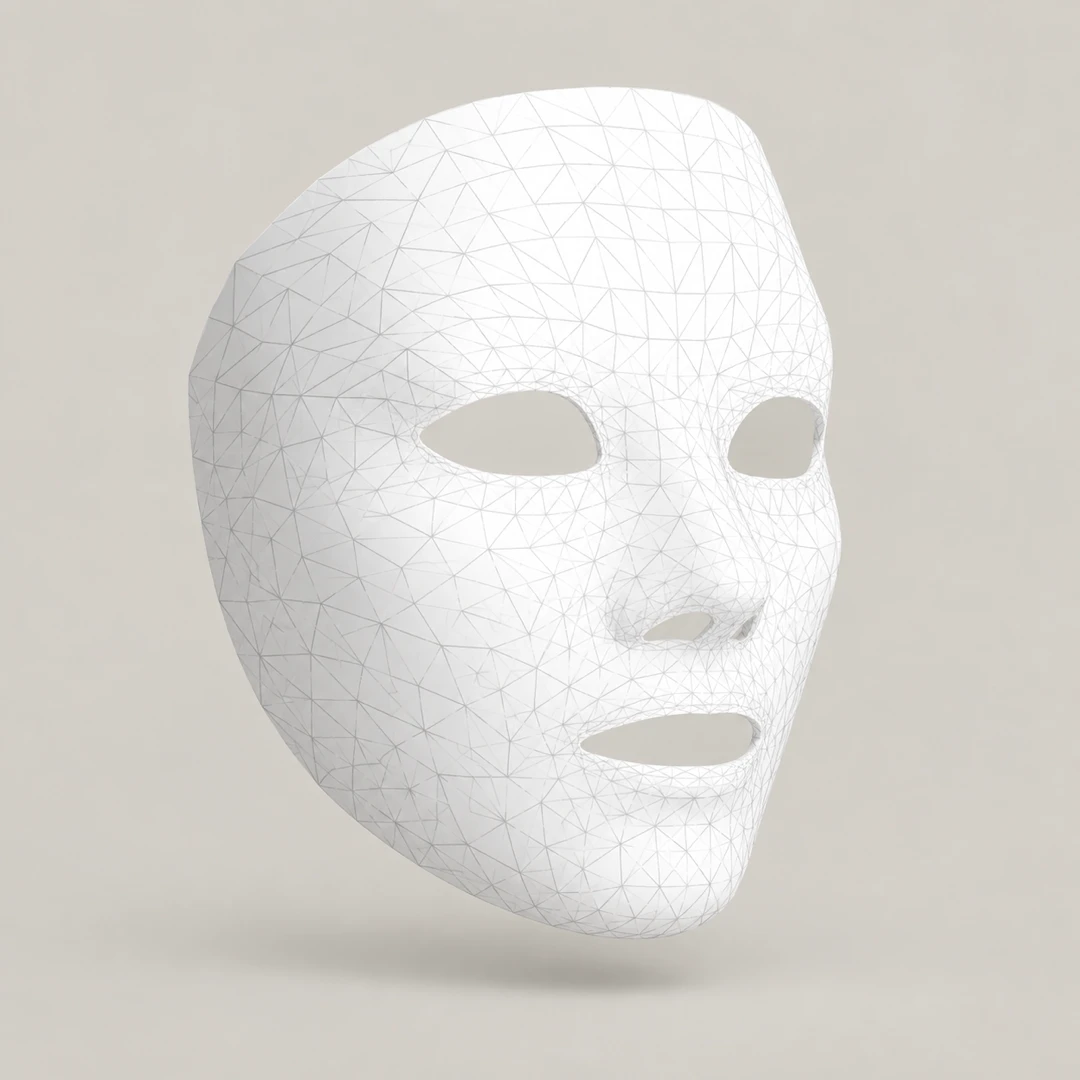
478 facial
Landmarks. One unique you.
Understand your face.
Make it your own.
Our browser tools analyze on your device. Your photo stays with you.
Explore how hair, grooming and styling can change your look.
19 app readings, with angles and proportions specific to your face.
See how readings are calculated, with research and limitations explained.
Why invest in your appearance?
From first impressions to dating and work, appearance can influence how others respond to you. Explore the research, then focus on the choices you can make your own.
What research found
People formed impressions after seeing a face for just 100 milliseconds. How you present yourself can be part of that first moment.
Willis & Todorov (2006) · Psychological Science (opens in a new tab)What research found
Different photos of the same person produced different impressions. One unflattering picture does not tell the whole story of your face.
Todorov & Porter (2014) · Psychological Science (opens in a new tab)Try it for yourself
Explore hair, frames and grooming that suit your proportions and taste. Start with one small change, then compare it in the same lighting.
Explore your face shapeWhat research found
A meta-analysis of job-related experiments found an advantage for attractive candidates. This reflects appearance bias, not greater ability.
Hosoda, Stone-Romero & Coats (2003) · Personnel Psychology (opens in a new tab)What research found
Photo choice can change perceived competence and trustworthiness. These are impressions of an image, not measures of your skills or character.
Todorov & Porter (2014) · Psychological Science (opens in a new tab)Try it for yourself
For a headshot or video call, try even lighting, a camera at eye level and grooming you feel comfortable with. Let your experience do the talking.
Explore your face shapeWhat research found
In speed-dating research, perceived attractiveness was associated with romantic interest. Looks can help spark interest; they do not establish compatibility.
Eastwick & Finkel (2008) · Journal of Personality and Social Psychology (opens in a new tab)What research found
The photos people preferred changed with the context, including online dating. Choose a recent image that represents how you actually look.
Todorov & Porter (2014) · Psychological Science (opens in a new tab)Try it for yourself
Use your face shape as a starting point for a haircut or frames, then let your preferences lead. Aim for a style you enjoy wearing in real life.
Explore your face shapeThese studies describe perceptions and associations, not results from using Symmi. Improving your presentation does not guarantee a job, a date or a particular outcome.
Find your starting point →Studies show
These are the published numbers Symmi scores against. Every reading is placed on a band drawn from measurements like these, not from an opinion.
6mm
A chin has to sit 6 mm off centre before an ordinary person notices. Eyelid 2 mm, mouth corner 3 mm, brow 3.5 mm, nose tip 4 mm.(1)
Wang, 2017. Aesthet Surg J.
93%
Of 100 people measured before eyelid surgery, 93% had at least 1 mm of left-right difference in brow or eyelid position.(2)
Macdonald, 2014. J Otolaryngol Head Neck Surg.
13→51%
The same men were judged attractive 13.5% of the time on a 50 mm lens and 51.1% on a 105 mm lens. Same faces, same light.(3)
Třebický, 2016. PLoS ONE.
30%
A selfie taken at 12 inches makes the base of the nose look about 30% wider than a photo taken from further back.(4)
Ward, 2018. JAMA Facial Plast Surg.
73%
73% of healthy newborns already had at least one head or neck asymmetry on the day they were photographed.(5)
Stellwagen, 2008. Arch Dis Child.
9.3mm
Jaw width read from a flat photo missed the caliper by 9.3 mm on average, with an agreement score of only 0.16.(6)
Lim, 2022. Front Public Health.
Evidence review
Every method people try on their face, graded on what has been measured. Most habits land on works a little. Styling changes the look, not the face. A few things only a clinic can do.
Chewing on both sides
for an even face
Works a little
A lifetime of one-sided chewing leaves the masseter about 1 mm thicker. Muscle only; the 748-person cohort found no effect on facial asymmetry.
Rajesh, 2024. Cureus; NFBC1986, 2024.
Read the review →
Chewing gum
for a sharper jaw
No evidence
58 adults, three sessions a day for six months. Bite force rose; masseter thickness and jaw shape did not change.
Jung, 2024. J Oral Rehabil.
Read the review →
Mouth taping
for face shape
No evidence
Ten studies, 213 patients in total, every one rated poor, none measuring a face. The monkey study used growing animals.
Rhee, 2025. PLOS ONE.
Read the review →
Mewing
for the jaw
No evidence
Zero trials. Real appliances worn daily by 1,251 growing children moved the jaw relationship by 0.02 degrees.
Batista, 2018. Cochrane.
Read the review →
Transformations
Explore how hair, grooming, makeup and presentation can change a look.
Find my starting point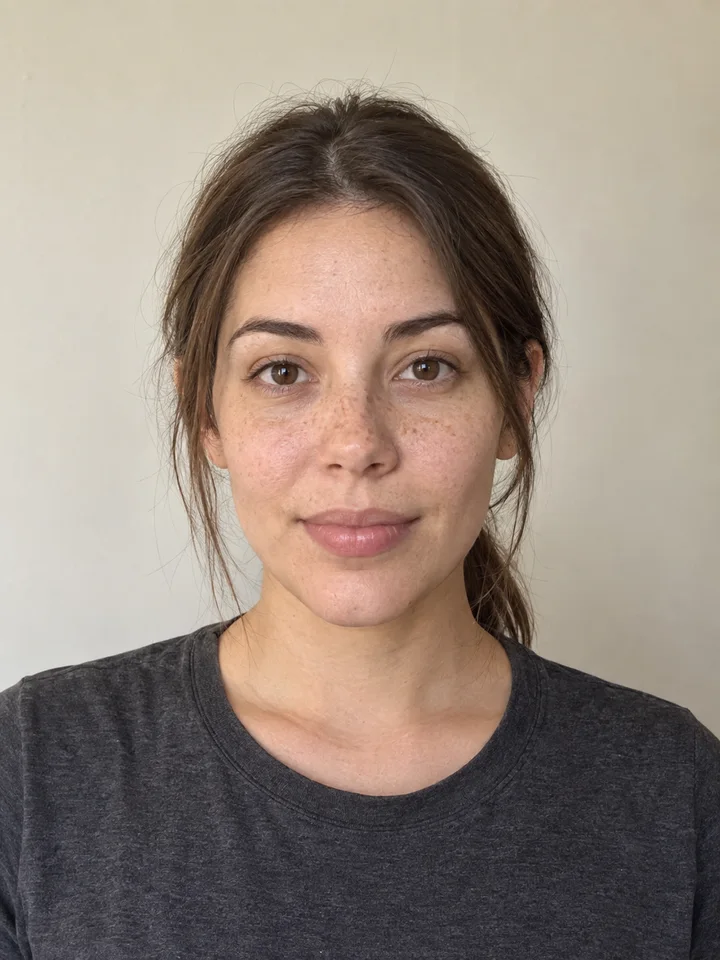









01 / 05
Face-framing hair, defined lashes and a warmer makeup palette. A new angle and window light complete the look.
Hair · Makeup · Presentation
AI-generated illustrations, not real customer results. Styling, angles and lighting all contribute to the differences shown.
What you get back
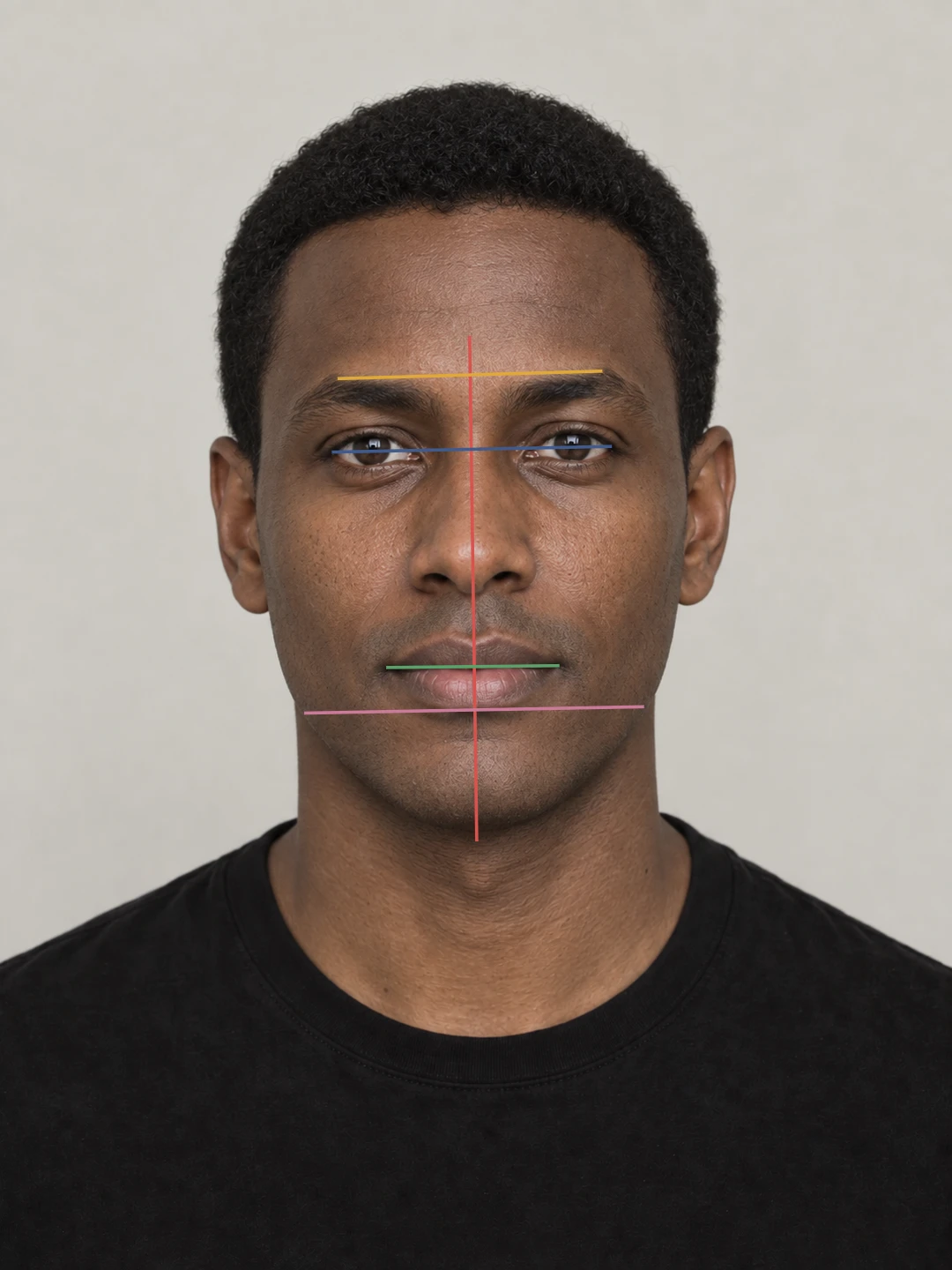
This is the photo after the free symmetry tool has placed its landmarks and drawn where each reading was measured. Real output on an example face; every number you get back points at one of these lines.
How it works
The old way
The new way
Why photos disagree
Lens, distance and a few degrees of head turn change the face in the frame before anyone measures anything. Symmi fixes the framing first, then reads the numbers.
What we measure
Free in your browser
Same face, three views
The browser tools read the front view. The app adds the three-quarter view, and on Face ID iPhones builds the full 3D model. Example face, generated for this page.

Measured in the browser

Measured in the app
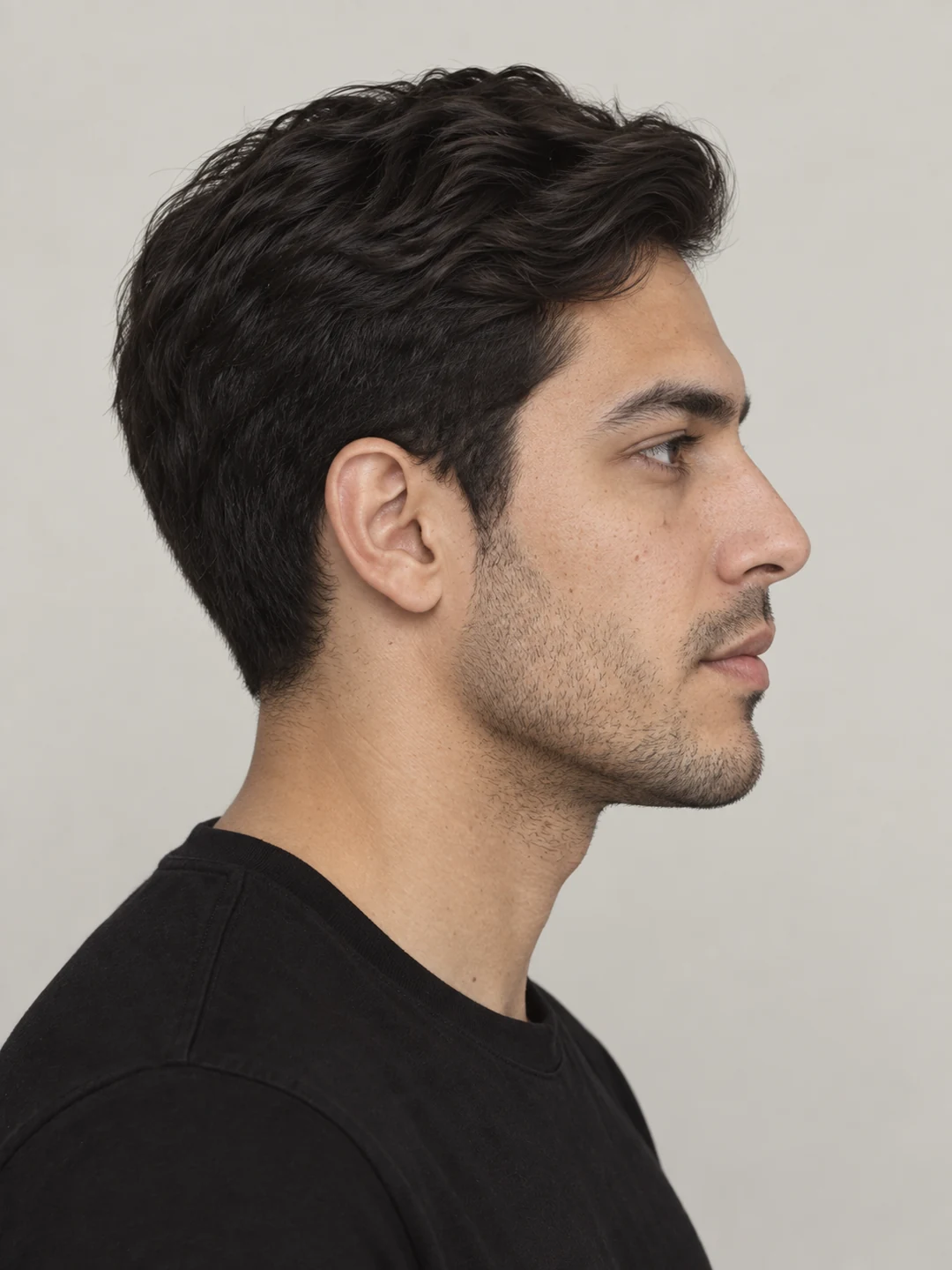
3D on Face ID iPhones
Precision
Three example faces were each measured five times: the original, tilted ±1.5°, downscaled to 90% and darkened by 15%. The spread is half the range between the highest and lowest run, taken from the worst of the three faces.(10)
Full repeatability table →| Reading | Unit | Runs | Spread |
|---|---|---|---|
| Symmetry index | 0–100 | 3 × 5 | ±0.5 |
| Chin offset | % of face width | 3 × 5 | ±0.2 |
| Canthal tilt | degrees | 3 × 5 | ±0.4 |
| Jaw angle | degrees | 3 × 5 | ±0.4 |
| Jaw : face width | ratio | 3 × 5 | ±0.01 |
| fWHR | ratio | 3 × 5 | ±0.01 |
| Midface ratio | ratio | 3 × 5 | ±0.01 |
Measured 2026-09-12 with the exact code that runs on this site. Lens distance is not part of this test and moves readings more than anything here; take the same kind of photo each time.
Inside the app
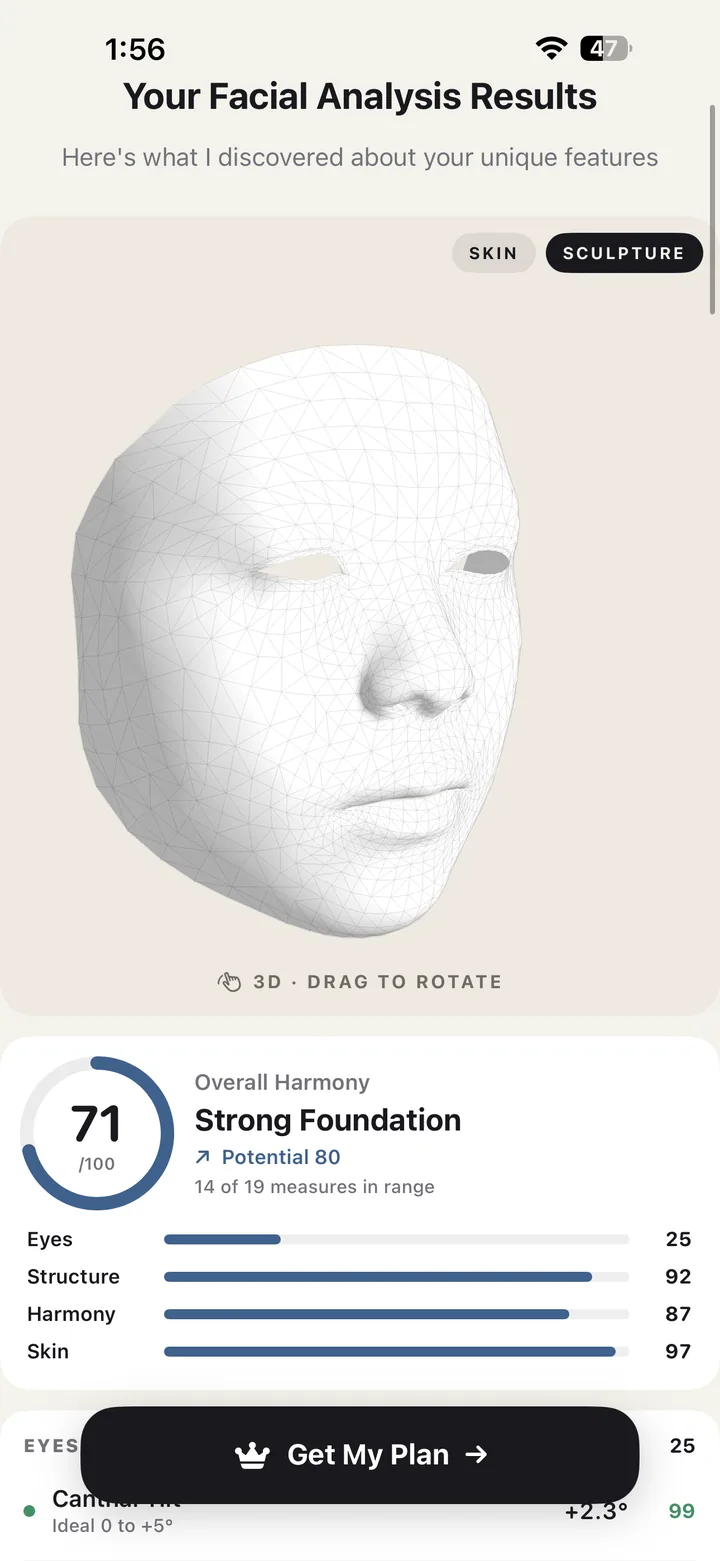
Every reading with its band
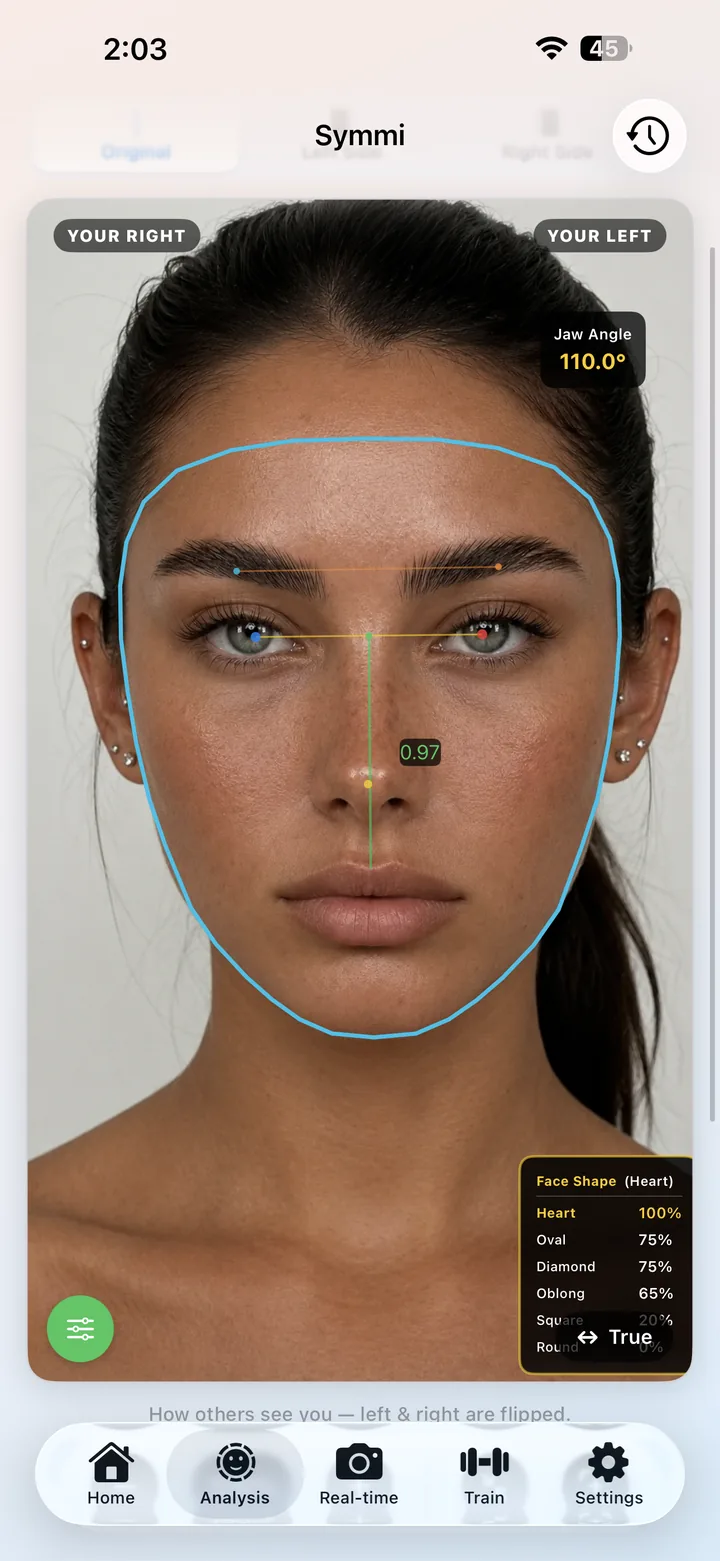
Angles and ratios, side by side
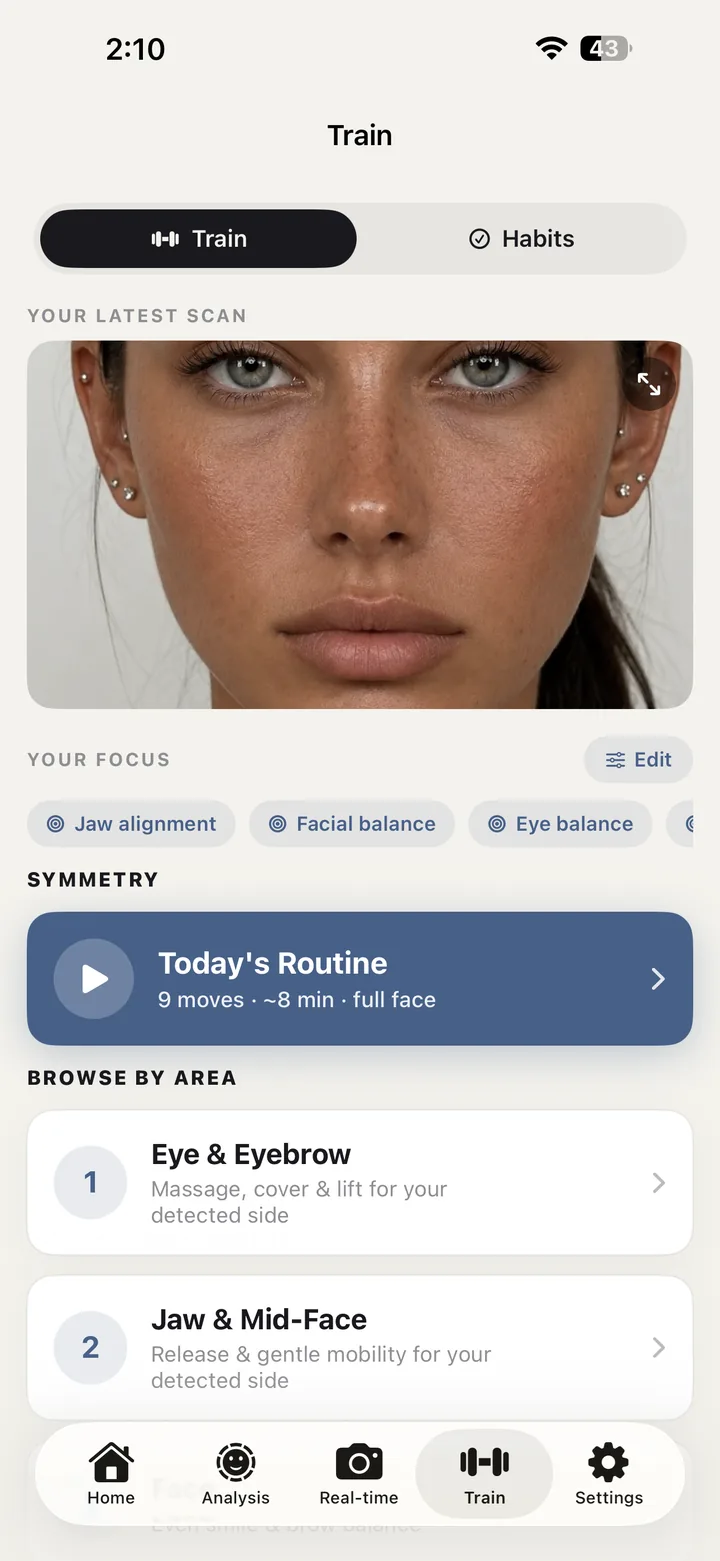
Gua sha, ice and a 30-day plan
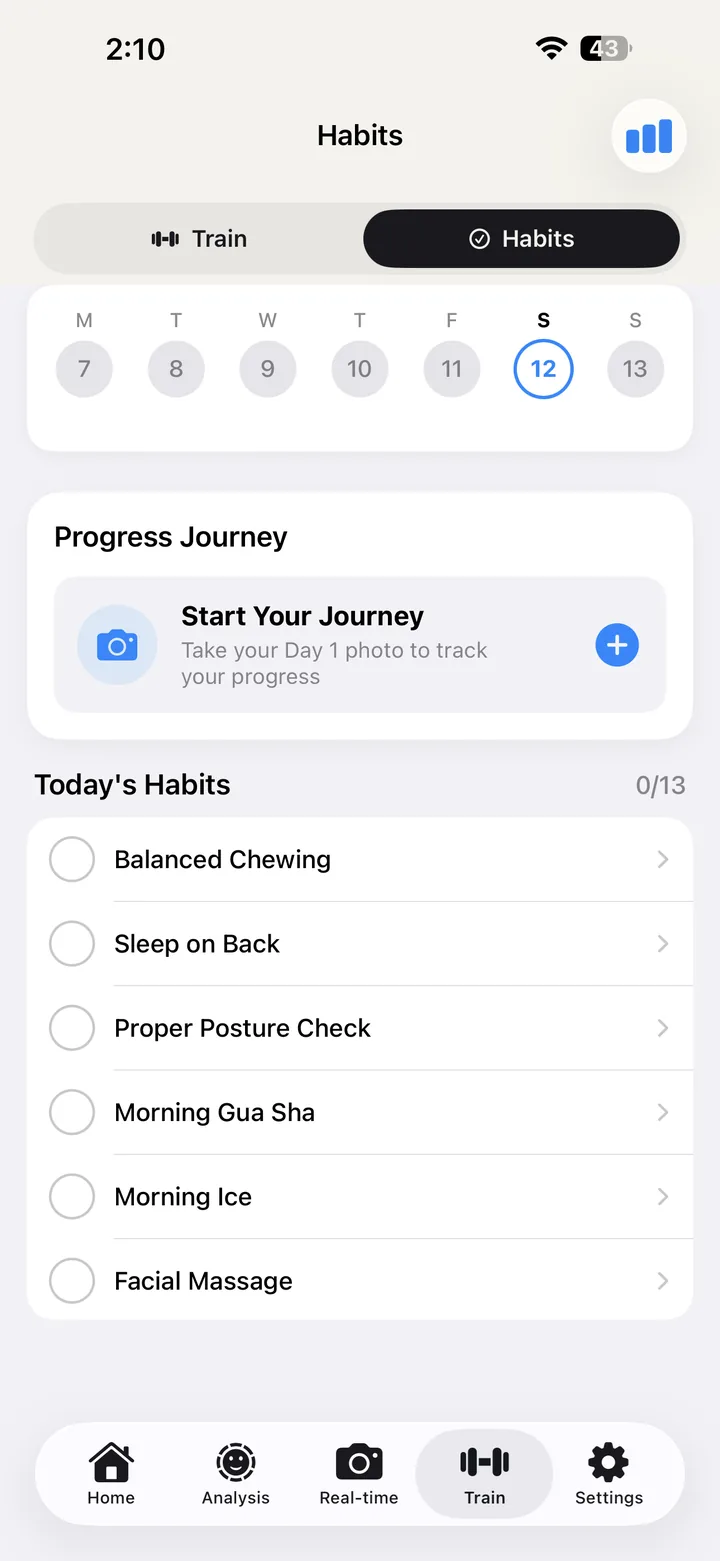
Track it
Every scan is stored on your phone with its readings. Rescan under the same light and framing and the app lays the two sets side by side, so a change shows up as a number rather than an impression. The routine sits next to it: gua sha, ice and a 30-day plan you tick off day by day.
Bone is given, habits are yours
147 pairs of identical twins, eight facial measurements. The pairs were pulled apart by what they did, not what they inherited. Symmi cannot move bone. It measures the parts that habits reach, and gives you a routine for them.(9)
Reading
Privacy
The browser tools place the landmarks and compute every reading inside your browser tab. Close the tab and the photo is gone. The app does the same on the phone: scans, readings and the 3D model are stored on the device, and nothing is uploaded to be analysed.
0
photos uploaded by the tools and app
On device
landmarks and readings
On device
scan history
FAQ
References